Israel’s military said it struck a Hamas commander who it said was hiding within the compound of Al-Aqsa Martyrs Hospital in Deir al-Balah, in central Gaza, while local health officials reported injuries in and around the medical site. The report placed the event inside a wider pattern of attacks that have continued despite the ceasefire announced in October 2025.
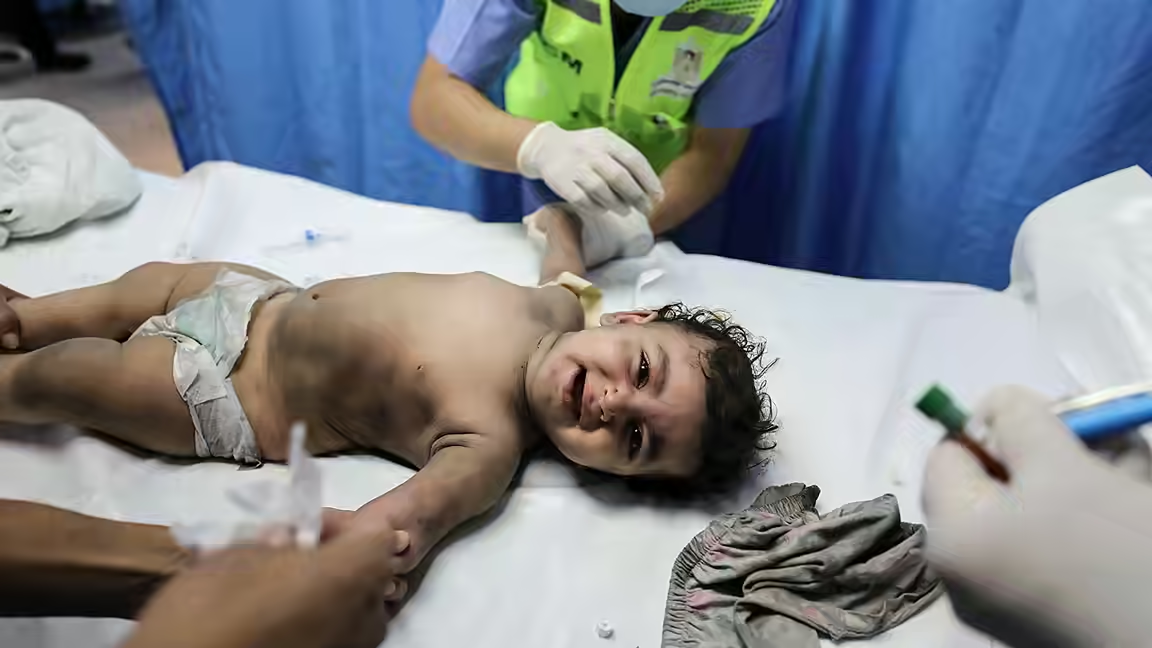
The supplied evidence says the military did not immediately confirm whether the alleged commander had been killed. It said the target was in a structure adjacent to hospital buildings rather than in the main wards. The hospital reported that three people were injured in a strike near a warehouse close to the maternity ward inside the compound. Earlier in the day, it said one person had been killed by Israeli fire in the eastern area of Deir al-Balah.
The same reporting also said an Israeli strike near a roundabout in Gaza City’s Tel al-Hawa neighbourhood killed two people and injured several others. That makes the hospital hit part of a multi-site day of violence rather than a single isolated incident. For readers, the key point is that medical facilities were still functioning enough to receive patients while being exposed to strikes nearby.
The New Arab report described the attack as the latest deadly violation of the US-backed ceasefire that took effect in October 2025. It also cited Palestinian health authorities saying Israeli operations in Gaza have killed at least 1,313 people since the truce began. The supplied evidence does not allow any independent verification of the toll, so the article should treat that figure as part of the source record rather than as a separately confirmed count.
Hospital compounds are especially sensitive sites in Gaza because they combine treatment areas, displaced civilians and emergency access in a territory where infrastructure has been severely damaged. A strike near the maternity ward is significant not because the supplied evidence proves a direct hit on patients, but because it shows violence reaching deep into a place meant for care and shelter.
The event date, 2026-08-29, therefore marks another moment in an already prolonged conflict in which ceasefire language has not prevented lethal incidents on the ground. The evidence supports a narrow conclusion: Israel said it targeted a Hamas commander at or near Al-Aqsa Martyrs Hospital, while Gaza officials reported injuries and other deaths elsewhere in the territory the same day.
The report matters because it shows how quickly a hospital compound can become part of the battlefield. Even when military claims are framed as precision targeting, the presence of wounded people near a maternity ward shows the limited protection civilians have inside Gaza’s remaining medical infrastructure. The supplied evidence does not confirm the commander’s fate, so the key news value lies in the injuries and the fact that another hospital-linked strike occurred despite the ceasefire language in place since 2025.
The report therefore lands at the intersection of military justification and civilian exposure, which is why it will be read less as a battlefield claim than as another warning about how fragile hospital safety remains in Gaza.