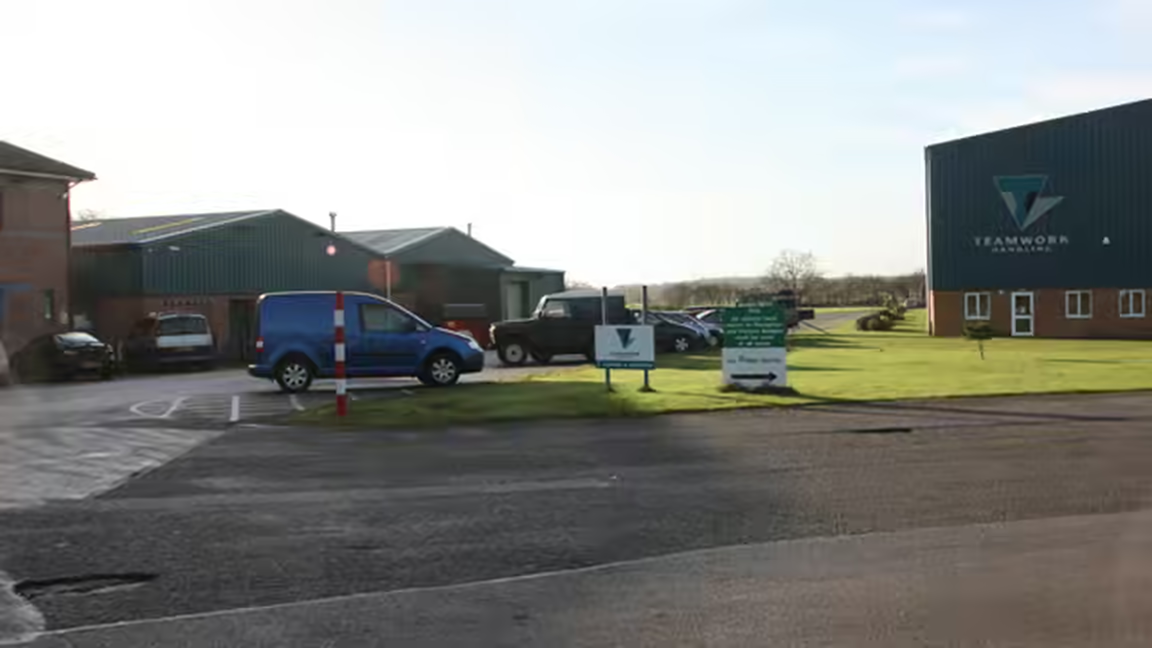
SLB has agreed to acquire Kelvion in a transaction that values the thermal-management company at about $4.1 billion including assumed debt, extending SLB’s push into the infrastructure behind large data centers. The agreement puts cooling and heat-transfer systems at the center of SLB’s effort to benefit from the rapid construction cycle surrounding artificial intelligence.
Under the announced terms, SLB will pay approximately $3.4 billion in cash and assume about $700 million of debt. Kelvion is being sold by funds managed by Apollo, its majority owner, and funds advised by minority investor Triton. The deal remains subject to regulatory approvals and customary closing conditions, with completion expected in the first half of 2027.
Cooling becomes strategic infrastructure
Kelvion makes heat exchangers and thermal-management systems for data centers, energy projects and industrial customers. Those systems are increasingly important as operators pack more computing capacity into facilities that must remove large amounts of heat while controlling electricity and water use. SLB argues that adding Kelvion will allow it to offer a more integrated package rather than treating cooling as a separate component.
The target is expected to generate between $2.3 billion and $2.4 billion in 2026 revenue, according to figures released by SLB. Data centers are described as Kelvion’s largest and fastest-growing market, with projected revenue of $1.2 billion to $1.3 billion this year. Kelvion also supplies equipment used in heat pumps, renewable-energy systems, carbon capture and industrial processing.
SLB’s existing data-center operation combines modular manufacturing, offsite construction, engineering and digital systems. The company says its approach can shorten the time needed to bring new capacity online by reducing the amount of complex work performed at the final construction site. Adding Kelvion would bring cooling hardware and thermal design more directly into that model.
Ambitious projections, with execution still ahead
SLB expects the acquisition to increase earnings per share and free cash flow per share during the first year after closing. It is also forecasting about $120 million in annual EBITDA synergies within three years, split between cost savings and additional revenue opportunities. Those figures are management projections rather than completed results and will depend on regulatory clearance, integration and continued demand for new data-center capacity.
On a pro-forma basis, SLB says the two companies’ data-center activities would produce more than $2 billion in 2026 revenue. The group is targeting between $4.5 billion and $5 billion in revenue from the combined data-center solutions business by 2028, with adjusted EBITDA between $700 million and $800 million.
The acquisition reflects a broader change in how traditional industrial and energy-technology companies view AI. The investment boom is not limited to chips and software: it is also creating demand for power, cooling, construction and facility integration. For SLB, Kelvion is a way to move deeper into those physical systems while retaining exposure to the energy and industrial markets it already serves.
The strategic case is clear, but the next phase will be practical. SLB must secure approvals, close the transaction and show that a century-old thermal-equipment business can be integrated into a fast-growing data-center platform without losing focus on its existing customers.